




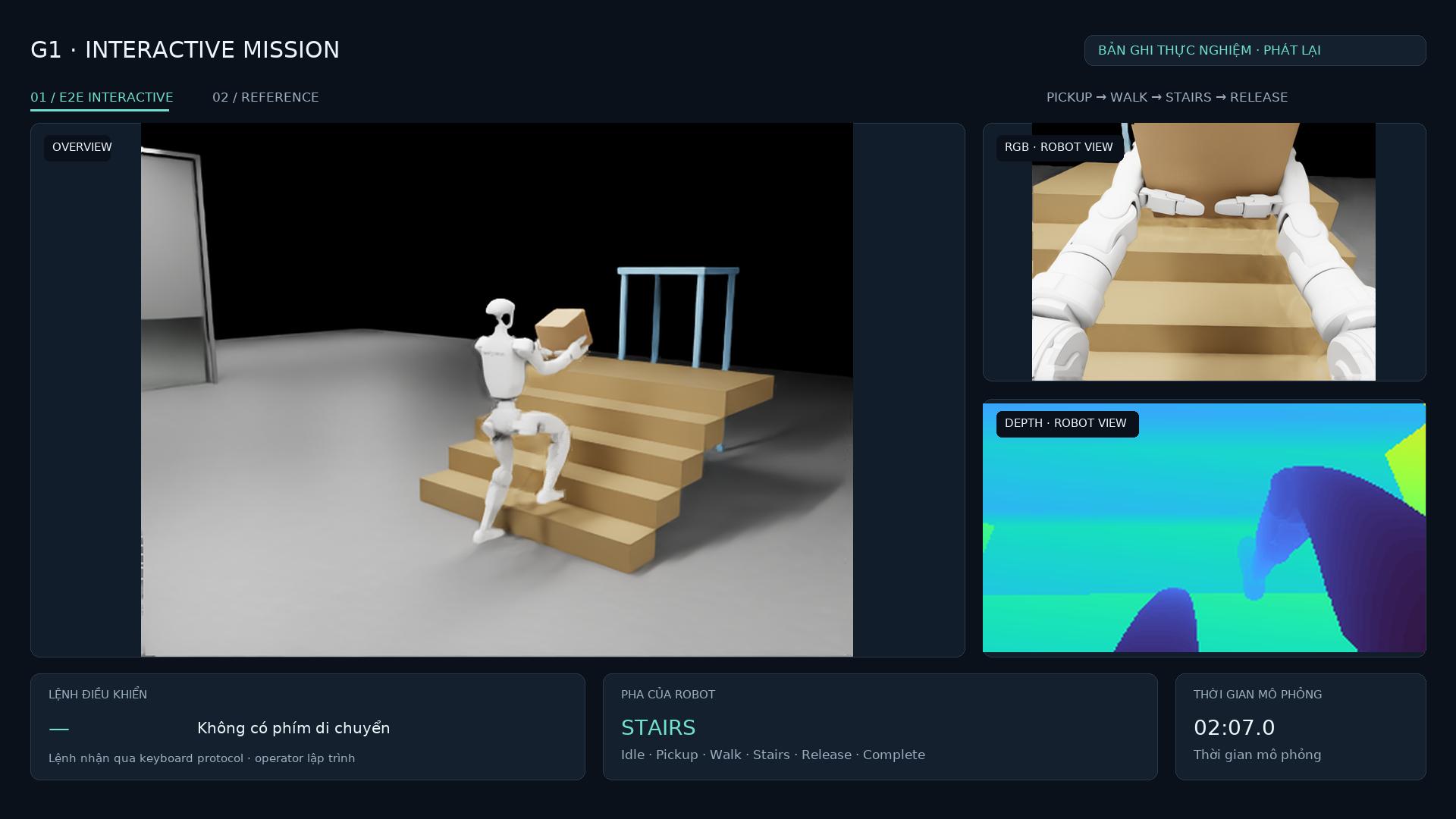
Unitree G1: Decoupled Hybrid RL Logistics
Developed a Decoupled Hybrid Architecture (Flow Matching + PPO) for a 43-DoF humanoid to autonomously execute a multi-floor warehouse mission with an 85% success rate.
AI · COMPUTER VISION · INTELLIGENT SYSTEMS
AI Student · Computer Vision · Applied AI
I build and study reliable perception systems across computer vision, video understanding, person re-identification, explainable AI, and production-oriented deployment.

I am an Artificial Intelligence undergraduate at FPT University - Can Tho Campus with hands-on work in computer vision, deep learning, video understanding, person re-identification, and deployable AI systems.
My work spans research, experimentation, and production-oriented engineering: from dataset preparation and model evaluation to ONNX/Docker deployment, full-stack platforms, technical leadership, and applied accessibility projects.

FPT University - Can Tho Campus — Bachelor of Artificial Intelligence · GPA 3.5 / 4.0 · 2023-2027 (expected)
Selected technical projects spanning applied AI, full-stack systems, accessibility, and research engineering.
Developed a Decoupled Hybrid Architecture (Flow Matching + PPO) for a 43-DoF humanoid to autonomously execute a multi-floor warehouse mission with an 85% success rate.
A production digital platform for Net Zero research, courses, events, and green-behavior governance at Vietnam National University, Hanoi.
An inclusive technology initiative exploring voice-driven web coding for people with disabilities, selected among the Top 10 GenAct STEAM for ALL projects.
An end-to-end CCTV video analysis pipeline using person detection, feature learning, attention, and temporal modeling for violence recognition.
Swipe horizontally to explore projects →
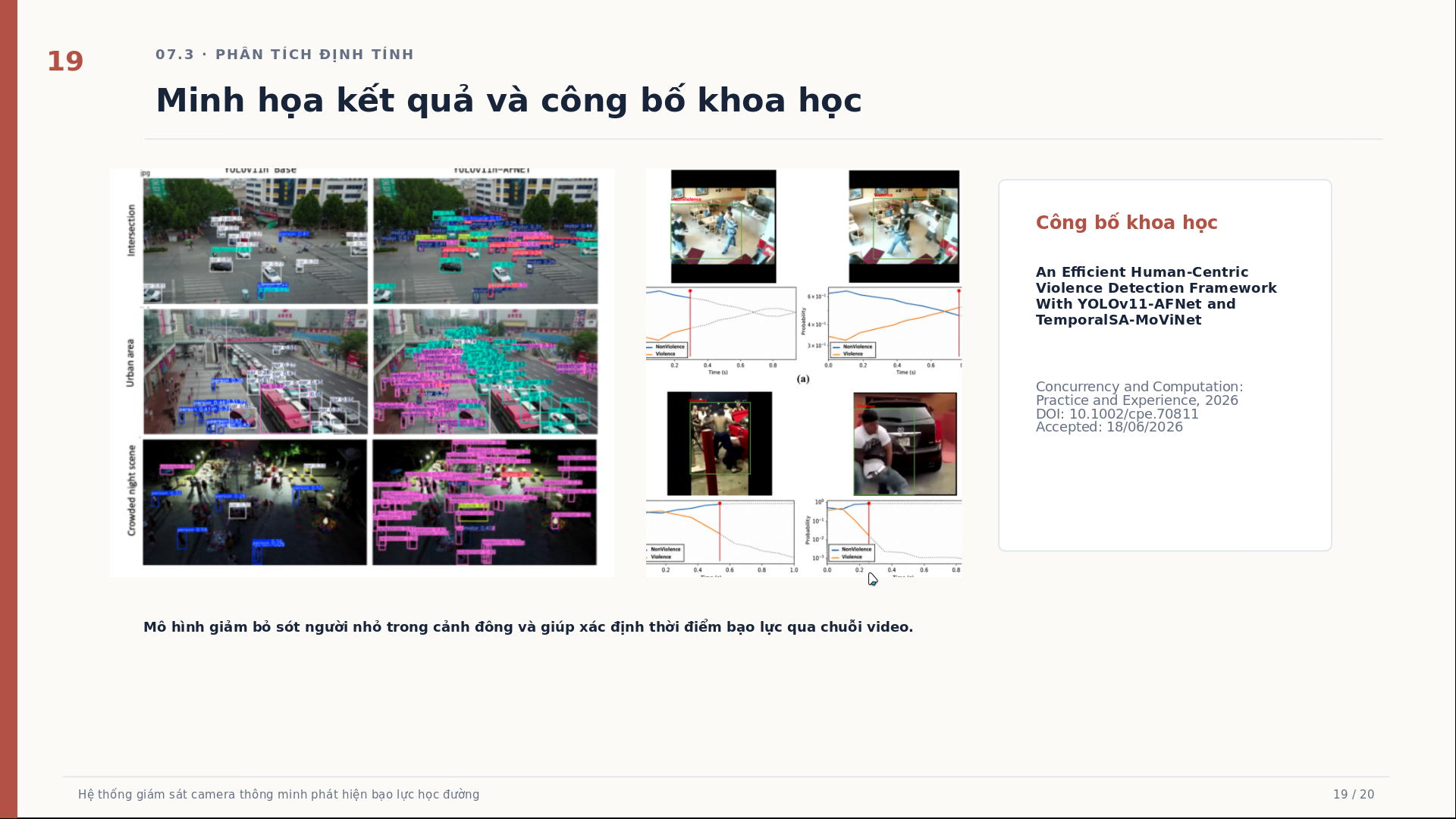
An end-to-end CCTV video analysis pipeline using person detection, feature learning, attention, and temporal modeling for violence recognition.
Enhanced OSNet with MDHA and Dynamic Graph Convolution and evaluated cross-camera retrieval on standard person Re-ID datasets.
Published work, accepted papers, and ongoing explainable-AI research.
Conference Paper
PDCAT 2026
Resource-aware quantum machine learning for speech emotion recognition, benchmarking QSVC, VQC, and QCNN-like classifiers across compact feature budgets, feature selection strategies, and classical baselines.
Speech emotion recognition (SER) is sensitive to speaker identity, feature redundancy, and evaluation protocols, while quantum machine learning introduces additional constraints related to qubit budgets, circuit design, and computational cost. This paper presents a resource-aware benchmarking framework for quantum downstream classification under compact feature budgets. A controlled evaluation uses 206 acoustic features and actor-disjoint splitting on RAVDESS, comparing quantum support vector classifiers (QSVC), variational quantum classifiers (VQC), and quantum convolutional neural network (QCNN-like) architectures across five feature selection strategies, including mutual information, mRMR, PCA loading, random selection, and QUBO-based optimization. Experiments investigate compact budgets of 4 and 8 features, with an additional 16-feature stress tier. On binary emotion classification, the best Macro-F1 scores reach 0.728 for QSVC, 0.709 for VQC, and 0.760 for QCNN-like models, while matched classical baselines achieve stronger predictive performance. Nested QUBO tuning produces promising improvements at eight features, although these gains do not remain statistically significant after Holm correction. Additional experiments extend evaluation to full eight-class RAVDESS and matched six-emotion RAVDESS/CMU-MOSEI settings, examining cross-corpus selector consistency, hardware-derived noise sensitivity, and quantum circuit ablations. Results show that the best eight-class quantum Macro-F1 scores remain below matched classical baselines, while only one of six cross-corpus quantum model-budget configurations preserves the best feature selector. Simulator runtime increases substantially at larger qubit budgets, particularly at 16 features, without consistent predictive improvements. These findings highlight the importance of leakage-controlled evaluation, architecture-dependent feature selection, and computational resource analysis in quantum speech emotion recognition, rather than establishing quantum predictive advantage.
Conference Paper
ICDSAIA 2026
Similarity-driven Grad-CAM++ explanations based on query-gallery similarity, with sensitivity analysis across person/background regions and retrieval outcomes.
Person re-identification (Re-ID) retrieves images of the same identity across non-overlapping camera views. Although modern Re-ID models are usually compared using Rank-1 accuracy and mean Average Precision (mAP), these metrics do not indicate whether a match is supported by person appearance or by contextual shortcuts such as background and camera-specific cues. This paper presents a failure-oriented explainability protocol for similarity-based person Re-ID. Instead of applying Grad-CAM to a classification logit, the explanation target is defined as the cosine similarity between query and gallery embeddings, aligning the explanation with the retrieval decision itself. The resulting similarity-driven Grad-CAM heatmaps are then combined with gallery-person masks generated by a pretrained DeepLabV3-ResNet50 segmentation model to quantify person foreground ratio (PFR), background reliance ratio (BRR), similarity drops under person/background masking, and a context-reliance score (CRS). Experiments on Market-1501 and MSMT17 with ResNet50, MobileNetV2, OSNet, and OSNet-AIN show that retrieval failures are consistently less person-grounded than correct easy matches. Across 714 mined query-gallery pairs, 631 valid segmentation-CAM pairs are retained after excluding invalid masks and flat heatmaps. Failure cases increase BRR from 0.340 to 0.437--0.481 on Market-1501 and from 0.337 to 0.446--0.469 on MSMT17, while person-region sensitivity decreases substantially. Statistical tests with Holm correction confirm the reliability of the main comparisons. A fill-strategy ablation using ImageNet-mean replacement preserves the same trend, reducing the risk that the findings are caused by black-mask artifacts. The results show that similarity-driven Grad-CAM, when quantified with person/background attribution metrics, reveals failure behavior not captured by retrieval accuracy alone.
Conference Paper
ICDSAIA 2026
Attention modules are widely used in person re-identification (Re-ID), but where they should be placed inside a multi-branch backbone is rarely isolated as an explicit design variable.
Attention modules are widely used in person re-identification (Re-ID), but where they should be placed inside a multi-branch backbone is rarely isolated as an explicit design variable. This paper studies that question in OSNet, whose OSBlock aggregates four branches with different effective receptive-field scales. We compare three placement strategies under a fixed protocol: Post, which applies one attention module after branch aggregation; SharedBranch, which reuses one module on all branches before summation; and IndBranch, which assigns a separate module to each branch. Four modules are evaluated: Aggregation Gate (AG), Efficient Channel Attention (ECA), Convolutional Block Attention Module (CBAM), and Coordinate Attention (CA). All variants are trained from scratch on Market-1501 and DukeMTMC-ReID with the same softmax cross-entropy recipe, without ImageNet pretraining, metric-learning losses, or re-ranking. The goal is not to establish a new state of the art, but to isolate how placement, parameter sharing, and module design affect OSNet behavior. Across AG, ECA, and CBAM, Post and SharedBranch are generally the most reliable choices, while IndBranch does not provide consistent gains despite its branch-specific parameter budget. AG-Post obtains the strongest Market-1501 result in the main comparison (Rank-1: 93.2%, mAP: 81.1%), while CBAM-Post gives the highest DukeMTMC-ReID mAP among the twelve main variants (68.1%). CA-SharedBranch is the major outlier: with BatchNorm, its mAP drops to 28.6% on Market-1501 and 21.9% on DukeMTMC-ReID. Replacing BatchNorm with GroupNorm restores it to 80.7% and 68.1% mAP, respectively. These results show that attention placement in multi-branch CNNs should be considered jointly with parameter sharing and internal normalization.
Conference Paper
ICDSAIA 2026
Drone-based maritime search-and-rescue (SAR) object detection is difficult because targets are observed from unstable aerial viewpoints, under changing sea-surface appearance, and at highly different scales.
Drone-based maritime search-and-rescue (SAR) object detection is difficult because targets are observed from unstable aerial viewpoints, under changing sea-surface appearance, and at highly different scales. In SeaDronesSee, boats are usually large and frequent, whereas swimmers, floaters, life jackets, and people on boats are small, rare, or spatially overlapping with vessels. This paper studies a lightweight modification of YOLO11s named DySample-ASFFLite. The proposed design keeps the YOLO11s backbone unchanged, replaces the two main top-down neck upsampling operators with DySample, and inserts a compact adaptive spatial feature fusion block, ASFFConcatLite, before the final three-scale detection head. A small/hard-category training-list rebalancing strategy is also used to expose the model more frequently to images containing life jackets and on-boat persons. For a controlled epoch-budget comparison, all overall results reported in the main tables are restricted to the 30-epoch point and evaluated on the same SeaDronesSee validation split. On the validation set, the YOLO11s baseline obtains mAP50:95 = 0.1854, whereas DySample-ASFFLite reaches 0.2130 at epoch 30 with 10.35M parameters and 24.8 GFLOPs in the unfused preflight summary. A qualitative comparison also shows that the proposed lightweight variant can recover additional small on-boat person detections that a larger YOLO11m baseline tends to miss or suppress. These results support further ablation training of dynamic upsampling and lightweight adaptive fusion for UAV maritime SAR detection.
Journal Article
Concurrency and Computation: Practice and Experience · Wiley
A spatial-temporal violence-recognition pipeline combining human-centric detection, feature learning, and temporal video modeling.
DOIIEEE Conference Paper
2026 IEEE 3rd International Conference on Big Data Science and Engineering (ICBDSE)
A lightweight YOLOv11 detector using GhostConv and C3k2Ghost for efficient real-time mango counting on resource-constrained systems.
Conference Paper
HUMAN 2026
Efficient aerial tiny-person detection through high-resolution and lossless feature representation for small-object perception.
Industry experience, technical mentoring, and leadership across AI, robotics, and youth programs.
Contributed to production-oriented AI workflows for enterprise use cases.
Lead club operations and technical activities for the campus AI community.
Supported student teams during AI and robotics competitions.
Coordinate youth programs around sustainability, green jobs, and capacity building.
Supported leadership and operations for campus environmental activities.
SAYNTAX selected among the Top 10 initiatives for pilot implementation.
Research project using MDHA attention and Dynamic Graph Convolution.
University programming and problem-solving competition.
Natural Language Processing specialization.
Grouped by domain, not ranked as equally proficient.
07. A little more human
Not every story is written in code. Some are made on the road, on campus, and behind the scenes.
A journal in the making. These illustrations are a preview; personal photographs are coming soon.
Take your time. Drag or swipe to wander.
 Illustrated preview
 Illustrated preview
 Illustrated preview
 Illustrated preview
 Illustrated preview
 Illustrated preview
No moments here yet. There is still a story to come.


 OpenCV
 YOLO
 Person Re-ID
 TensorFlow / Keras
 Python
 C / C++
 NumPy
 Pandas
 Statistics
 ONNX
 TensorRT
 Docker
 Linux
 REST APIs
 Next.js
 TypeScript
 PostgreSQL
 ESP32
 ROS / ROS2
 Git