Unitree G1: Decoupled Hybrid RL Logistics
Developed a Decoupled Hybrid Architecture (Flow Matching + PPO) for a 43-DoF humanoid to autonomously execute a multi-floor warehouse mission with an 85% success rate.
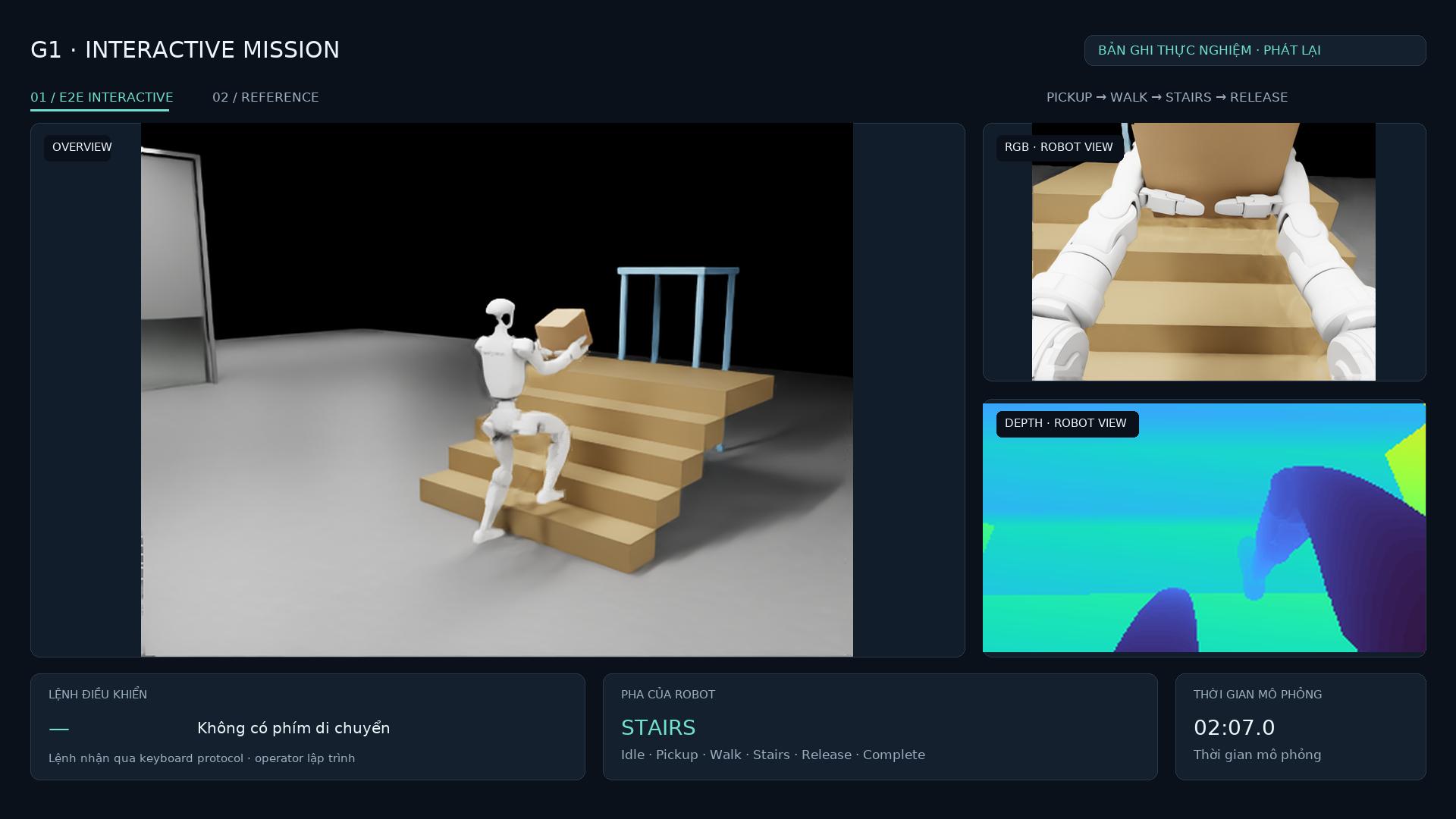
Overview
An autonomous logistics mission in Isaac Sim where a Unitree G1 humanoid approaches a shelf, picks up a 1.0-2.0 kg box relying purely on RGB vision (Q-Critic proxy), navigates a five-step stair environment using Dual-Depth cameras, and safely releases the payload.
Problem
Standard monolithic RL policies suffer from severe skill interference (0% success) and actuator torque overshoots (spiking to -74.33 Nm) when forcing a single network to handle both low-frequency precision manipulation and high-frequency loaded locomotion.
Target Users
AI Researchers, Robotics Engineers, Tech Recruiters
My Role
AI / Robotics Researcher
Co-designed the Decoupled Hybrid Architecture. Engineered the Visuomotor Flow Matching policy (DiT) for grasping, the payload-aware Asymmetric PPO for stair traversal, and the 43-joint central dispatcher.
My exact contribution
- Trained a 32-layer DiT (Flow Matching) manipulation expert guided by a vision-based Q-Critic, eliminating the need for unreliable tactile sensors.
- Developed a Payload-Aware Locomotion Teacher (Asymmetric PPO) with custom Foothold Penalties to prevent backward heel slips, later distilled via DAgger.
- Engineered the Central 43-Joint Dispatcher utilizing a 0.5s Linear Blending Handoff to merge manipulation and locomotion policies without hardware-violating torque spikes.
- Executed comprehensive ablation studies across 20 randomized seeds to benchmark Monolithic vs. Decoupled approaches.
Key Features
- Decoupled Hybrid Architecture
- Vision-based Q-Critic Proxy
- Payload-Aware Locomotion
- 0.5s Linear Blending Handoff
- Strict Torque Bounding (±50 Nm)
Challenges & Trade-offs
- Preventing massive torque spikes (-74.33 Nm) during direct-switch controller handoffs.
- Mitigating skill interference between static upper-body manipulation and dynamic lower-body stabilization.
- Ensuring the robot does not slip when carrying forward-shifted payloads on narrow stairs (0.25m depth).
Lessons Learned
- Monolithic Multi-Task Distillation is critically bottlenecked by skill interference in complex humanoid control.
- A deterministic Central Dispatcher with linear target interpolation is essential for safe transition dynamics.
- Vision-based proxies (Q-Critic) are vastly more reliable for grasp confirmation in simulation than simulated contact forces.
Results
Achieved an 85% autonomous mission success rate over a continuous 71.14s rollout, completely eliminating torque spikes and keeping actuations safely within ±50 Nm limits.
Proof Artifacts